Sunday, 29 April 2018

Aspheric indeed: Tamron AF Aspherical 28-80 1:3.5-5.6 77D

Cost for lens: $14 (average market price $10)

I was very excited to test an auto focus lens on the electronic Viltrox adapter. In theory, the adapter should be able to auto-focus on any EF of EF-S mount lens. But practice and theory are not always the same ... And this lens proved that point. Although it made some focus noise, it was actually not moving the focus at all. Either the lens is not compatible, or the lens was damaged. But it did pass on all the EXIF data, and that was nice after shooting a few years with all manual lenses.


So the lens was tested in manual mode. And I did not find that a pleasant experience with this lens. The focus barrel range was short, so accurate focus was difficult resulting in many missed photo's.
Completely built from plastic, including the mount, it felt very cheap, although the rubber grip on the zoom barrel gave a good grip.


Image quality was disappointing with lack of focus, color fringing on the edges, and rather flat colors that were adjustable in Lightroom. Not to surprising as Tamron lenses of this age do not have the best reputations, especially the cheaper zoom lenses such as this one.


I do understand that by going aspherical, quality was sacrificed for a lower cost, and I also understand that the 77D model was one of the early models. Maybe the later models saw some improvements.
You could consider this a cheap walk-around lens for a rainy day where you do not care if the lens survives the shoot, but my conclusion is that I'm going to pass on other cheap Tamron lenses. There are plenty better lenses to find at this price level.


Lens Specification:
Focal Length: 28-80mm
Maximum Aperture: F3.5-5.6
Minimum Aperture: 22
Image Format: 35mm
Lens Mount: EF
Optics: 7 elements, 7 groups?
Blades: 6?
Focusing: Auto and Manual
Minimum Focus: 70mm
Filter Size: 58mm
Weight: 247g
Length: 77-90mm
Production: +/- 1995
Serial Number: 100965
Made in: Japan

Company: 
This company was founded in Japan by Mr. Takeyuki Arai in 1950 under the name of Taisei optical Equipment Manufacturing. In 1957, it developed is first lens, a 135mm F/4.5 and introduced the T-Mount, allowing lenses to be used on different mounts by just swapping out the T-adapter. The less popular Adaptall mount was released in 1979 and was able to mechanically communicate aperture information.
In 1958, the brand of Tamron was registered, named after the late designer of optical components, Uhyoue Tamura, who laid the foundations of the company's technical expertise.
Tamron is now owned for 11.38% by Sony, and is one of the few remaining independent lens manufacturers.

Aspherical:
The aspherical elements in the front group reduced the number of elements required, resulting in cheaper and lighter lenses.

AF:
Auto Focus capability

Adapter:
VILTROX Mount Adapter EF-NEX II
Cost: $40, used on eBay


This electronic adapter allows Canon EF and EF-S lenses to be mounted on Sony E-Mount APS-C format cameras. It is capable of providing Auto-Focus with more recent lenses (trial and error to find compatible lenses). The electronic connection, if used with a modern lens will be able to provide EXIF data such as shutter speed, aperture, focus length and ISO. As this is a glass-free adapter, you do get the crop factor when used with APS-C camera's such as the Sony a6000. Although a cheap adapter, it's solidly made, and provided a tight mount of the lens.

Samples:

1/100 sec - f/8 - 30mm - ISO100 - Handheld

1/60 sec - f/8 - 30mm - ISO100 - Handheld

1/320 sec - f/7.1 - 32mm - ISO100 - Handheld

1/200 sec - f/7.1 - 30mm - ISO100 - Handheld

1/125 sec - f/18 - 28mm - ISO100 - Handheld

1/160 sec - f/4 - 30mm - ISO125 - Handheld
Sources:

Thursday, 19 April 2018

A lens with many names: Kalimar MC Auto Zoom 1:3.9 80-200mm

Cost: $19.99 (average market price $25)


It seems this push-pull Tele-Zoom was released under many different brand names, such as Prospec, Sakar, JC Penny, Nikura, Star-D, Ritzcam, Zykkor, Sirius, Craig optics and finally Samyang, who seems to be the manufacturer.

The claim to fame is in the fixed aperture across the whole zoom range as this is not to common amongst cheaper tele-zooms. Aperture works smooth, but with distinct clicks for each stop. The push-pull zoom/focus ring is also smooth, and resistant enough to avoid zoom-creep when holding the zoom down. That's pretty handy for shooting Macro. To bad the Macro itself is kind of worthless.

Image quality is somehow lacking. Not very sharp, and a lot of color fringing on the sides. Colors were OK after some light touches in Lightroom. Bokeh is rather messy.. not smooth at all.

So in short.. not a keeper. Image quality was average or less and I didn't like the handling. To bad, as build quality was actually above average, and Kalimar lenses are now always having bad reviews. But as we all know, even good lenses have variations between them. Rating: average.

MC: Multi-coated, chemical coating to combat partial reflection.

Auto: Ability to mechanically communicate aperture information to the camera. Does not work on current digital camera's.

Lens specification:

Focal Length: 80-200mm
Maximum Aperture: F3.9
Minimum Aperture: F22
Image Format: 35mm
Lens Mount: PK
Optics:
Blades: 6
Focussing: Manual
Minimum Focus: 130cm
Filter Size: 55mm
Weight: 612g
Length: 136-146mm
Production: +/- 1983
Serial Number: K87127487
Made in: Korea?

More information on Kalimar

Samples:
All pictures taken with the Lens Turbo II adapter


1/400 sec - ISO400 - Handheld

1/640 sec - ISO400 - Handheld

1/1250 sec - ISO400 - Handheld

1/640 sec - ISO400 - Handheld

1/250 sec - ISO400 - Handheld

1/160 sec - ISO400 - Handheld

1/400 sec - ISO400 - Handheld

1/1600 sec - ISO400 - Handheld

1/1000 sec - ISO400 - Handheld

1/400 sec - ISO400 - Handheld

1/125 sec - ISO400 - Handheld

Monday, 9 April 2018

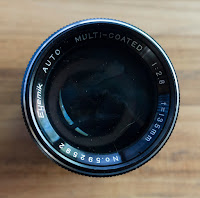
In the eye of the beholder: Eyemik Auto Multi-Coated 1:2.8 135mm

Cost: $14.99 (average market price $22)


It was bound to happen some day, but this was the first time someone asked me via the comments about a lens I had not reviewed yet. So I had to take it out soon...

This is a smart looking lens! Stylish looks professional... but looks can deceive.

Handling mixed.. smooth aperture and focus ring, almost old style Pentax like, but regrettably difficult to focus, resulting in many unsharp photo's.

Image quality isn't horrible, but some color fringing on the edges, and most often rather soft in sharpness. Colors were decent, but needed some tweaking in Lightroom to make them pop. Bokeh was nice and smooth, but nothing extraordinary.

It's not a bad lens, and I was able to get a few good pictures, but for the budget, I'm sure you can get better. After all it's not that hard to make a good prime lens. So being mediocre might not be good enough. I guess it's in the eye of the beholder!

Multi-Coated: Chemical coating to combat partial reflection.
Auto: Ability to mechanically communicate aperture information to the camera. Does not work on current digital camera's.

Lens specification:

Focal Length: 135mm
Maximum Aperture: F2.8
Minimum Aperture: F22
Image Format: 35mm
Lens Mount: MD
Optics: 5 elements in 4 groups
Blades: 6
Focussing: Manual
Minimum Focus: 25cm
Filter Size: 58mm
Weight: 398g
Length: 76-87mm
Production: ?
Serial Number: 592592
Made in: Japan

More information on Eyemik

Samples:


ISO 100 - 1/320s - Handheld

ISO 100 - 1/320s - Handheld

ISO 100 - 1/250s - Handheld

ISO 100 - 1/320s - Handheld

ISO 100 - 1/400s - Handheld

ISO 100 - 1/400s - Handheld

>ISO 100 - 1/200s - Handheld

ISO 100 - 1/250s - Handheld

ISO 100 - 1/125s - Handheld

ISO 100 - 1/1000s - Handheld

ISO 100 - 1/1000s - Handheld
Sources:
m42lens.com

Sunday, 25 March 2018

A Cheap Combination: the SMC Pentax-FA 80-200mm 1:4.7-5.6 plus the Pentax K10D

Cost for lens: $29.99 (average market price 55.80$)
Cost for K10D: average market price 100$, but can be found for as low as 40$)


As this is a true Pentax auto-focus lens, I thought it to be a good occasion to find my old Pentax K10D in a drawer, charge the batteries and take it out for a spin. The K10D was introduced on 2006, so we are shooting with 12 year old digital camera. Will it be able to hold up?

The K10D was the first DSLR from Pentax with a sensor higher then 10 megapixels (10.2 MP) and introduced then advanced features such as in-camera Shake Reduction and Dust Removal. It won several awards in the year it was released. The in camera Shake Reduction is useful with older or cheaper lenses that have no build in Anti-Shake. Even todays some DSLR's do not have that feature yet.

It was actually a lot of fun to take this combination out. I have been shooting manual for the last 2 years, not owning any native lenses for my Sony a6000, so the auto focus made for a more relaxed shooting experience. Next time, I will take out my wife's old K20D.

The Pentax-FA 80-200 is a good looking lens, with little weight for this range. But to achieve the low weight, they used all plastic, including the mount, giving a cheap feeling. The finish is not to bad though, and the lens works pretty smooth. When using manual aperture, I do miss the velvety smooth feel of the older Pentax lenses.

With an aperture of 4.7 to 5.6, it is not a fast lens, so mainly for daylight shooting, or up that ISO. Auto-focus was OK for a camera-lens combination of this age. As I'm not used shooting auto-focus with my Sony, I can't really compare. But it felt good, reminding me of my film days.

A little disappointing in the image quality, and I don't believe it was due to the limited number of pixels of the K10D. It just lacked sharpness... not that uncommon for zooms with such a range from that period. Colors are good, with little color fringing. Bokeh is OK, but nothing special.

So, not the best in today's standards, but as you can get this combination on eBay for under 100$, it's really not that bad. If you have a very low budget, but would like to start playing with a DSLR, this is not a bad combination, but maybe start with a cheap 50mm prime lens first.

Lens Specification

Focal Length: 80-200mm
Maximum Aperture: F4.7-5.6
Minimum Aperture: F32
Image Format: 35mm
Lens Mount: Pentax K
Optics: 11 elements in 7 groups
Blades: 8
Focussing: Auto Focus
Minimum Focus: 110cm
Filter Size: 49
Weight: 270g
Length: 110mm
Production: 1999 to 2004
Serial Number: 6343354
Made in: Taiwan

More information on Pentax

Samples:
1/500 sec - f/11 - 88mm -  ISO400 - Handheld

1/800 sec - f/8 - 80mm - ISO400 - Handheld

1/800 sec - f/9.5 - 113mm -  ISO400 - Handheld

1/800 sec - f/8 - 200mm -  ISO400 - Handheld

1/800 sec - f/11 - 200mm -  ISO400 - Handheld

1/800 sec - f/8 - 180mm -  ISO400 - Handheld

1/500 sec - f/8 - 200mm -  ISO400 - Handheld

1/500 sec - f/11 - 128mm -  ISO400 - Handheld

1/500 sec - f/4.5 - 128mm -  ISO400 - Handheld

1/1600 sec - f/5.6 - 128mm -  ISO400 - Handheld

1/1600 sec - f/5.6 - 93mm -  ISO400 - Handheld

1/60 sec - f/11 - 143mm -  ISO400 - Handheld
Sources: